The River Climbed the Stairs
THIS IS A WORK OF FICTION
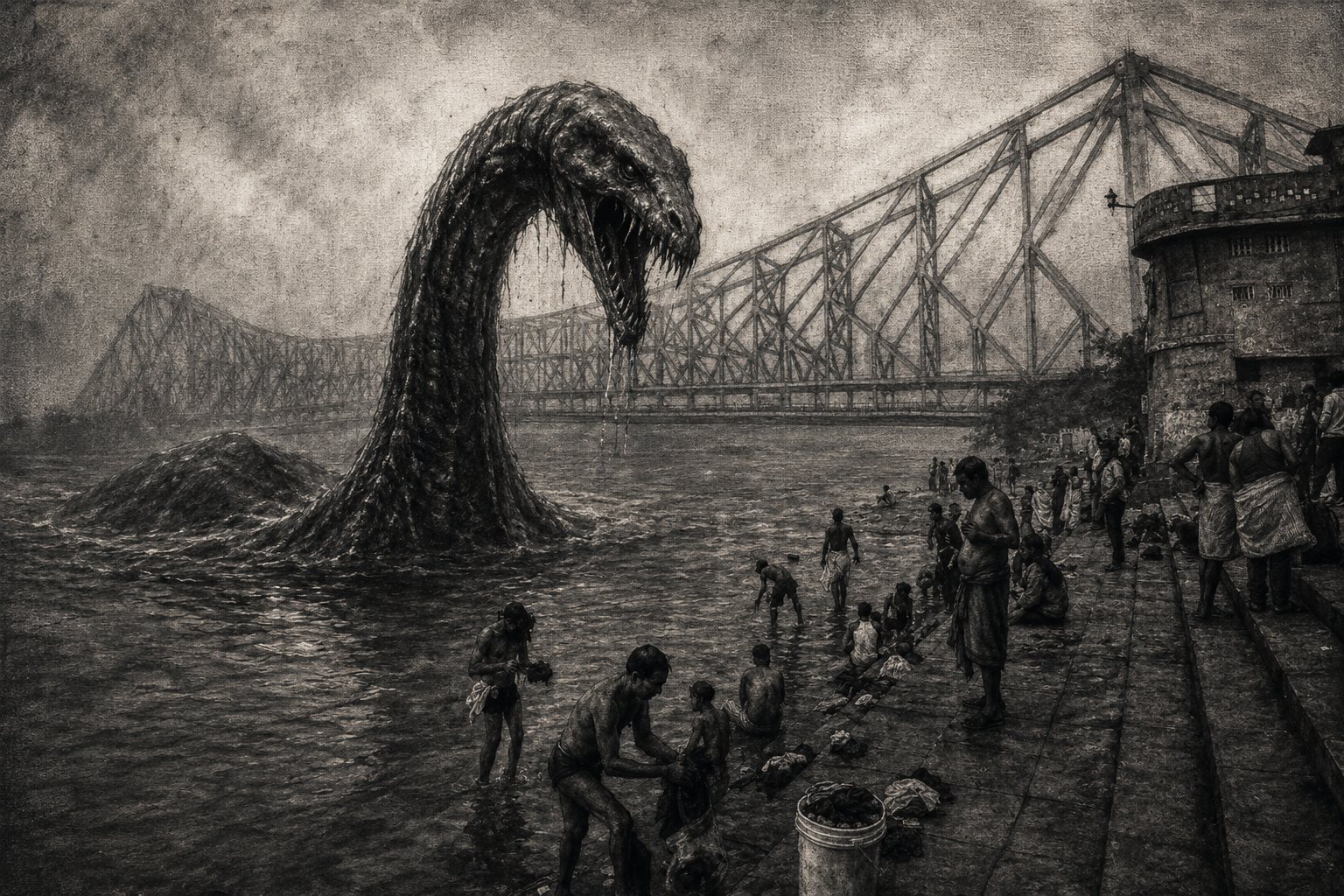
By four-thirty in the morning, Mallick Ghat already had the worried look of a railway platform before a riot. The Howrah Bridge hung overhead in its iron arrogance, black against a sky just beginning to pale, while below it the flower market performed its daily miracle of converting exhaustion into commerce. Men with sleep still pasted in their eyes carried baskets of marigold, jasmine, hibiscus, bel leaves, and roses. Women squatted on damp gunny sacks, their fingers moving faster than gossip. A boy in a torn football jersey dragged a blue plastic drum through a puddle and called it imported water. Tea steamed in small glasses. Incense competed with fish stink, diesel, wet rope, old flowers, sweat, and that grand Calcutta perfume of a drain which has read the Upanishads and found them insufficient.
The heat had not left during the night. It had merely crouched in the city’s corners like a dog with a bad temperament.
“Today people will boil in their own vests,” said Mina, tying garlands without looking up.
Gobinda Pal, who ran the tea stall near the steps, lifted his kettle from the coal stove and said, “Speak softly. The heat has ears.”
“The heat also has a stomach,” Mina said. “It ate my husband and left me his debts.”
She was forty-two, which in the flower market meant she had been old for ten years and would remain old for another thirty. She wore a faded green sari tucked high at the waist, her wrists hard as bamboo. Her son, Riju, sat beside her on an upturned crate, pretending to study for his railway exam while actually watching the river. The book in his lap had the noble title Quantitative Aptitude and the practical weight of a brick.
Gobinda liked the boy. Riju had the pale, underfed seriousness of young men who had been told all their lives that education was a staircase and had found, on reaching the top, that somebody had removed the building.
“Tea?” Gobinda asked.
“No money today, kaku.”
“Did I ask for biography? Drink.”
Riju smiled, embarrassed, and took the glass.
Already the devotees were arriving, thin men in wet gamchhas, clerks with office bags, widows with brass lotas, taxi drivers, two giggling college boys, three women from Burrabazar who had come to offer flowers and steal ten minutes of river-cool relief before returning to kitchens where ceiling fans moved like tired lawyers. Heat had made everyone religious. The river, which on ordinary days received plastic packets, ashes, sins, and municipal indifference, had become Mother again by emergency order.
Gobinda watched them descend the steps.
He did not bathe in the Hooghly. Not since his younger brother Bhola had vanished from these same steps in 1997, in a monsoon current the color of boiled tea. One moment Bhola had been laughing, slapping water at him; the next, the river had folded over him with the soft efficiency of a clerk closing a file. They never found the body. Their mother had kept Bhola’s metal school tiffin box for nineteen years, as if hunger might bring him home.
The morning began to make its wrongness known in little ways.
The river was too still.
Not calm. Still. There is a difference. Calm water breathes. This water held itself like a man hiding behind a door.
A smell came up from it, cold and black, not the usual Hooghly rot but something of wet stone, peat, and old fish buried under snow. Gobinda had never smelled snow. Yet he knew it the way one knows a stranger has entered the room before turning around.
At the lowest step, a priest named Nirmal Chatterjee rang a bell with more confidence than devotion. He had lately acquired a laminated board reading SPECIAL PUJA FOR HEAT RELIEF, ₹101 ONLY, which annoyed Gobinda because it showed the ruthless Bengali talent for entrepreneurship in the face of apocalypse. Nirmal was a smooth man with sandalwood paste on his forehead and unpaid credit at every stall within a quarter mile. He believed in God, income, and receipts, though not necessarily in that order.
“Come, come,” Nirmal called. “Take Ma Ganga’s blessing. Heat will reduce. Mind will cool.”
“The river is smelling funny,” Mina said.
“It always smells funny,” Gobinda replied.
“Not like this.”
Riju had stopped pretending to read. “Last night there was a video,” he said. “Somebody saw a long neck near the bridge. Like that foreign monster.”
“What foreign monster?”
“Loch Ness. From Scotland.”
Mina snorted. “As if Scotland has nothing better than sending monsters to our drainage.”
Riju looked wounded. “It was moving against the current.”
“Everything in Calcutta moves against sense,” Gobinda said, but he too looked at the water.
At first the thing appeared as a line.
A dark ridge moved beneath the surface beyond the bathers, smooth and slow, parallel to the steps. A log, Gobinda told himself. The river was full of logs, idols, dead dogs, political banners, and once a sofa, drifting majestically past like a retired judge. But this was not drifting. It turned.
A woman waist-deep in water shrieked and laughed together, the sound people make when fear has not yet received its official stamp.
“Machh!” someone shouted. Fish.
The ridge dipped.
A circle spread.
Then an old man disappeared.
No splash worth mentioning. No theatrical foam. He simply went down as if an unseen hand had taken him by the ankles. His brass lota floated up, bumped once against another bather’s hip, and began to spin.
For one second, everyone waited for the old man to surface, because life, though cruel, is usually not so prompt.
He did not surface.
The river broke open.
A head rose from the Hooghly, long and black-green, water streaming from it in sheets. The neck behind it curved like a question nobody wanted answered. Its eyes were small and bright, set too far forward, with the intelligent vacancy of a crocodile and the mournful patience of something that had spent centuries being misunderstood by folklore. Its mouth opened sideways, wider than seemed mechanically decent.
The first scream went up like a flare.
The creature took a man in a white vest from the waist. The vest remained visible for a moment, stretched between jaws, then vanished. The crowd surged backward. People slipped on algae. A woman dropped her child; Mina was already running down the steps before Gobinda knew she had moved.
“Riju!” she screamed.
The boy stood frozen at the middle step, book still in hand, as though the railway exam had included this section and he had not revised properly.
Gobinda ran.
He had not run in years. His knees had opinions, his lungs filed objections, his stomach bounced with middle-aged resentment. Yet he ran, knocking aside a basket of roses, sliding on wet stone, grabbing Riju by the collar just as the river erupted again.
The monster’s neck came forward, impossibly long. Its head struck the steps where Riju had stood, cracking stone. A smell of fish, iron, and winter flooded Gobinda’s face. The eye, black with a rim of yellow, turned toward him.
Not hunger.
Recognition.
Gobinda dragged Riju upward. Mina seized her son’s arm and slapped him, once, hard, then pulled him against her so fiercely the boy gasped.
“Move!” Gobinda shouted.
The crowd became a single animal with too many limbs. Devotees ran half-dressed through the flower market. Garlands flew. Brass plates rolled. Someone’s slipper landed in Gobinda’s tea. Nirmal Chatterjee tried to climb over a stack of crates and fell into hibiscus, crying, “Ma! Ma! Ma!” with excellent pronunciation.
Behind them came the sound that would return in Gobinda’s sleep for whatever remained of his life: a heavy wet dragging.
The creature climbed.
It placed one flipper, broad as a door, on the lowest step. Then another. Its body rose from the river with the terrible reluctance of a hill deciding to walk. It was larger than any story had promised, black-green, ridged, scarred with pale patches like old burns. Water poured from it into the cracks of the steps. Its long neck swung left, right. It did not roar. That was the worst part. It breathed. A deep, patient, bellows breath, as if the massacre were work.
People say panic is chaos, but Gobinda later understood it had a pattern. The rich ran toward cars. The poor ran toward alleys. Priests ran toward donation boxes. Mothers ran toward children. Men who had lectured all their lives on courage discovered urgent appointments elsewhere.
A hand caught Gobinda’s wrist.
Nirmal.
“Help me,” the priest gasped.
His right foot was trapped between two flower crates. Gobinda should have pulled free and run. Instead he bent, shoved one crate aside, and yanked Nirmal out. The priest scrambled up, leaving his sandal behind.
The creature’s head came down among the garlands.
It did not eat the flowers. It smelled them.
Then it turned toward Nirmal.
For the first time that morning, the priest stopped making noise.
On his forehead, beneath the sandalwood paste, a small smear of black mud glistened. Gobinda noticed it because the creature noticed it. The monster lowered its head. Its nostrils flared.
Nirmal whispered, “No.”
It took him.
Not with rage. With selection.
The head snapped forward; Nirmal was gone from the waist up, his legs kicking twice on the wet stones before the rest followed. A bell rolled from his hand and came to rest near Gobinda’s shoe, still trembling.
Riju vomited behind a stack of marigolds.
The police arrived late, which is to say they arrived at the speed of institutions. Two constables came first, saw the creature standing half in the flower market, and retreated with the tactical wisdom of men earning government salaries. Later there would be barricades, officers, television vans, ministers, experts, denials, and a retired professor from a channel nobody watched explaining that mass hysteria was common among heat-stressed populations.
But for those first minutes, there was only Gobinda, Mina, Riju, the fleeing market, and the impossible animal between river and road.
“Inside,” Gobinda said.
He pushed Mina and Riju into the old flower godown behind his stall, a long room with a tin roof, cracked walls, and the smell of damp straw. He slammed the wooden door and dropped the iron bar. Outside, something heavy crushed his tea stall. Glass broke. His kettle gave a brief metallic scream.
“My stall,” he said stupidly.
Mina, shaking, said, “Your stall can reincarnate.”
They crouched among sacks of wilting petals. Dust fell from the rafters.
Riju wiped his mouth. “It looked at you, kaku.”
“Many creatures look at me. Creditors also.”
“No. Like it knew you.”
Gobinda said nothing.
Outside, the monster moved through the market. They heard baskets splitting, bamboo poles cracking, bodies scrambling, the squeal of metal shutters being pulled down by men who had never done anything so quickly in their lives. Somewhere a goat bleated once and was silent. The Howrah Bridge above continued to carry traffic, because Calcutta will permit the supernatural but not disruption of commute.
Mina clutched her son’s wrist. “What was that mud on Nirmal’s head?”
Gobinda did not answer quickly enough.
She looked at him. “You saw.”
He had.
Not ordinary mud. Black mud. Thick, shining, almost blue. The same mud he had seen once before, caked under Bhola’s fingernails when the river had returned one thing only: a torn strip of his shirt caught in a bamboo pole three days after he vanished. Their mother had kept that too, washed and folded, because grief in middle-class homes becomes inventory.
Gobinda shut his eyes.
The memory he had edited for twenty-nine years opened its drawer.
Bhola had not simply vanished. Gobinda had been angry that day. Bhola had stolen two rupees from him for phuchka, had laughed, had called him fat Gobu in front of a girl selling flowers. Gobinda, fourteen and proud in the stupid explosive way of boys, had pushed him. Not hard. Never hard enough to kill. But Bhola had slipped on algae, hit the water badly, and the current had taken him.
Gobinda had shouted for help. That part was true.
He had never told anyone about the push.
Now, in the godown, with the monster breathing outside, he tasted that old lie like a coin under his tongue.
Riju whispered, “Kaku?”
Before Gobinda could speak, the far wall of the godown shuddered.
Once.
Twice.
The tin roof flexed. Mina pulled Riju down. A plank split. Through the crack, an eye appeared.
Small. Wet. Yellow-rimmed.
It looked not at Mina. Not at Riju.
At Gobinda.
Then the creature withdrew.
A new sound came: metal dragging stone. The bell. Nirmal’s bell was being pulled across the ground.
Clang.
Pause.
Clang.
Pause.
Gobinda’s stomach turned cold.
“It wants something,” Mina said.
“They all want something,” he said.
“Don’t joke.”
“I am not joking.”
He crawled to the rear door, opened it a hand’s width, and peered into the lane behind the godown. Empty except for torn flowers, a bicycle, and a political poster peeling from a wall, its smiling candidate promising development with the expression of a man who had misplaced both concept and verb.
“We go out back,” Gobinda said. “Toward Strand Road. Then police.”
Mina looked at him sharply. “And you?”
“I am also coming.”
But even as he said it, he knew this was false.
The bell sounded again.
Clang.
A childhood voice rose in him: Gobu, see how deep I can go.
He had not heard Bhola’s voice in years. He had worked hard not to. Work, tea, accounts, blood pressure tablets, rent, small jokes, large silence. Respectability is often only cowardice wearing a clean shirt. He had built a whole life out of not remembering the exact angle of his brother’s fall.
Mina saw his face change.
“What is it?”
Gobinda reached into a corner and took up an old iron boat hook used for pulling sacks from vans during rain. Ridiculous weapon. One might as well threaten a cyclone with a spoon.
“Take Riju.”
“Kaku,” the boy said. “Come.”
Gobinda smiled at him. It surprised him; it felt almost natural.
“You have railway exam. Government job. Then you can ignore poor people officially. Go.”
Riju began to protest, but Mina pulled him. At the door she stopped.
“You are hiding something,” she said.
“Yes.”
“Will it save us if you stop hiding?”
Gobinda looked toward the front of the godown, where the bell dragged again.
“I don’t know.”
“That is the first honest thing said in this market today,” Mina replied, and fled with her son into the lane.
Gobinda waited until their footsteps vanished. Then he lifted the iron bar from the front door.
The market outside looked as if a storm had learned appetite. Flowers carpeted the ground, crushed into paste by flippers and feet. Red hibiscus bled into orange marigold. His tea stall lay flattened. The monster stood near the steps, head raised toward the bridge, Nirmal’s bell caught in its teeth by the leather strap. It shook its head once. The bell rang.
Clang.
Gobinda stepped out.
“Here,” he said.
The head turned.
The creature watched him.
“You came for the wrong man first,” Gobinda said. His voice shook. He was embarrassed by that, then embarrassed by being embarrassed. “Very Bengali, this. Even monsters stand in queue badly.”
It moved toward him.
Behind its left eye was a scar shaped like a crescent. Gobinda saw it and stopped breathing. Bhola had such a scar above his eyebrow from falling against a window latch when he was six. Their mother had dabbed turmeric on it. Bhola had howled as if personally betrayed by civilization.
The monster lowered its head until its eye was level with Gobinda’s.
In that black center, he saw not his reflection, but the river steps of 1997. Two boys. One push. One slip. A mouth opening under the water, not to devour, but to receive. The long neck rising unseen beyond the current. Bhola’s hand reaching upward, not for help.
For the bell.
Gobinda understood then what Nirmal had hidden.
Every summer of terrible heat, every season when the river ran low and foul, Nirmal had performed a private puja before dawn. Not for the goddess. For the thing beneath. He had rung the bell, smeared himself with black river mud, and given it goats, dogs, once perhaps a body no one would claim. In return, it stayed below, a rumor with teeth. But this year Nirmal had grown practical. Goats were expensive. Dogs had vanished from the area. Bodies had paperwork. Devotees came free.
The black mud marked the keeper.
And Bhola, poor laughing Bhola, had not drowned.
He had been chosen by accident and kept by design.
Gobinda’s knees weakened. “I pushed him,” he whispered. “I pushed him.”
The creature opened its mouth.
Inside was not darkness. Inside were sounds. Bells, river water, children laughing, men bargaining, women calling prices, the wet slap of bodies bathing at dawn, twenty-nine years of Calcutta pretending not to see what it had fed so long as business continued by six.
Then, from deep within the throat, came Bhola’s voice, older now and younger forever.
Gobu, move.
Gobinda turned.
At the top of the steps, Riju stood in the lane, staring, Mina behind him with one hand over her mouth. The monster’s neck had already begun to coil toward the boy. Not because it wanted him.
Because he had black mud on his fingers.
Riju had touched Nirmal’s bell when he vomited.
Gobinda ran between them.
He did not think of redemption. Redemption was too grand, too expensive, a word for people with drawing rooms. He thought only of Bhola’s tiffin box, of his mother folding a torn shirt, of Mina’s hand gripping her son’s wrist, of all the cheap lives Calcutta counted only when blocking traffic.
He swung the boat hook at the bell strap.
The iron caught leather. The bell tore free from the monster’s teeth and flew down the steps, ringing madly, bouncing toward the river.
The creature followed it.
Its great body slid, crashed, twisted. Stone cracked beneath it. Gobinda felt the wind of its neck pass his face. The monster lunged after the bell as if after a heart. It struck the lowest steps, overbalanced, and half-fell into the Hooghly with a sound like a building collapsing underwater.
For one moment its head rose again.
It looked at Gobinda.
In its eye, the crescent scar glimmered.
Then the river took it.
Not swallowed. Welcomed.
By seven, the news vans had come. By eight, the authorities had explained that there had been a gas leak, a stampede, heatstroke, river turbulence, anti-social elements, and one unfortunate reptile of manageable size. By nine, someone had put a plastic chair where Gobinda’s tea stall had been and begun selling tea.
Mina found Gobinda sitting on the steps, the torn bell strap in his hand.
“You saved him,” she said.
Gobinda looked at Riju, alive and pale, holding his exam book as if it were a passport.
“No,” Gobinda said. “I was late.”
That afternoon, when the tide went down, they found Nirmal’s ledger in a tin box behind the shrine. There were columns for flowers, oil, priest fee, special heat puja, and one column marked simply Deep Offering. Dates went back decades. On the page for July 1997, beside that same phrase, someone had written in a careful hand: boy, unpaid, accepted.
Gobinda knew the handwriting.
His father’s.
He sat with the ledger until evening, while the city around him resumed itself with obscene competence: buses honking, hawkers shouting, office-goers complaining about delay, the bridge glowing above the river like an old machine that had seen everything and learned nothing.
At dusk, Mina brought him tea from the new stall.
In the cup, floating on the surface, was a flake of black mud.
From the river came a bell, ringing once under the water.